
Why My Portfolio Opens Like a Movie
I've rebuilt my portfolio more times than I can count. Every developer has. You pick a template, swap in your name, dump your projects into a grid, call it done. It works. It's fine. But it never felt like me.
This time I wanted something different.
The Problem With Every Portfolio Ever
Open any developer portfolio. What do you see?
A big headline — "Hi, I'm [Name]." A subtitle — "Full Stack Developer." Maybe a wave emoji. A hero image or an illustration. Scroll down, here's my projects, here's my experience, here's a contact form.
It's functional. But it's forgettable. You close the tab and forget whose site you were just on.
I kept asking myself: if someone lands on my site, what do I want them to feel? Not read, not learn — feel. Before they know what tech I use or how many projects I've shipped, what's the vibe?
And the answer was: this guy is different.
Where the Idea Came From
I was watching a behind-the-scenes video of a Christopher Nolan film — I think it was Oppenheimer. There's this shot where the camera slowly rotates around a character, and the whole mood shifts just from the movement. No dialogue. No text on screen. Just a person, a turn, and a light source.
That stuck with me.
Around the same time, I was playing around with my phone camera, recording myself in a dark room with a single light source behind me. I noticed something — when I slowly turned away from the camera toward the light, it looked cinematic. Like a movie poster coming to life. The silhouette, the glow wrapping around the edges, the mystery of not seeing my face anymore.
I thought: what if my portfolio opened with that?
Not a static photo. Not a generic hero section. A slow, deliberate turn — controlled by the visitor. They scroll, I turn. They're not just reading my portfolio. They're directing it.
The Scroll-as-Playback Concept
The idea of tying video playback to scroll position isn't new. Apple does it with their product pages. But I hadn't seen anyone do it with a personal video on a portfolio. Most scroll-driven animations use product shots or 3D renders. This would be me — literally me — turning in the frame.
That felt powerful. Instead of telling people "I build cool things," I was showing them one. The portfolio itself becomes the proof.
I also loved the idea that every visitor has a slightly different experience. Some people scroll fast — they see a quick dramatic turn. Some people scroll slowly, pausing, reading each text card. Some people scroll back up and watch me "un-turn." The interaction is the same but the experience is personal.
The Five Acts
Once I committed to the scroll-driven video, I needed to figure out what to say during the turn. A video playing on scroll is cool for about 3 seconds. After that, it needs narrative.
I broke it into five acts, like a short film:
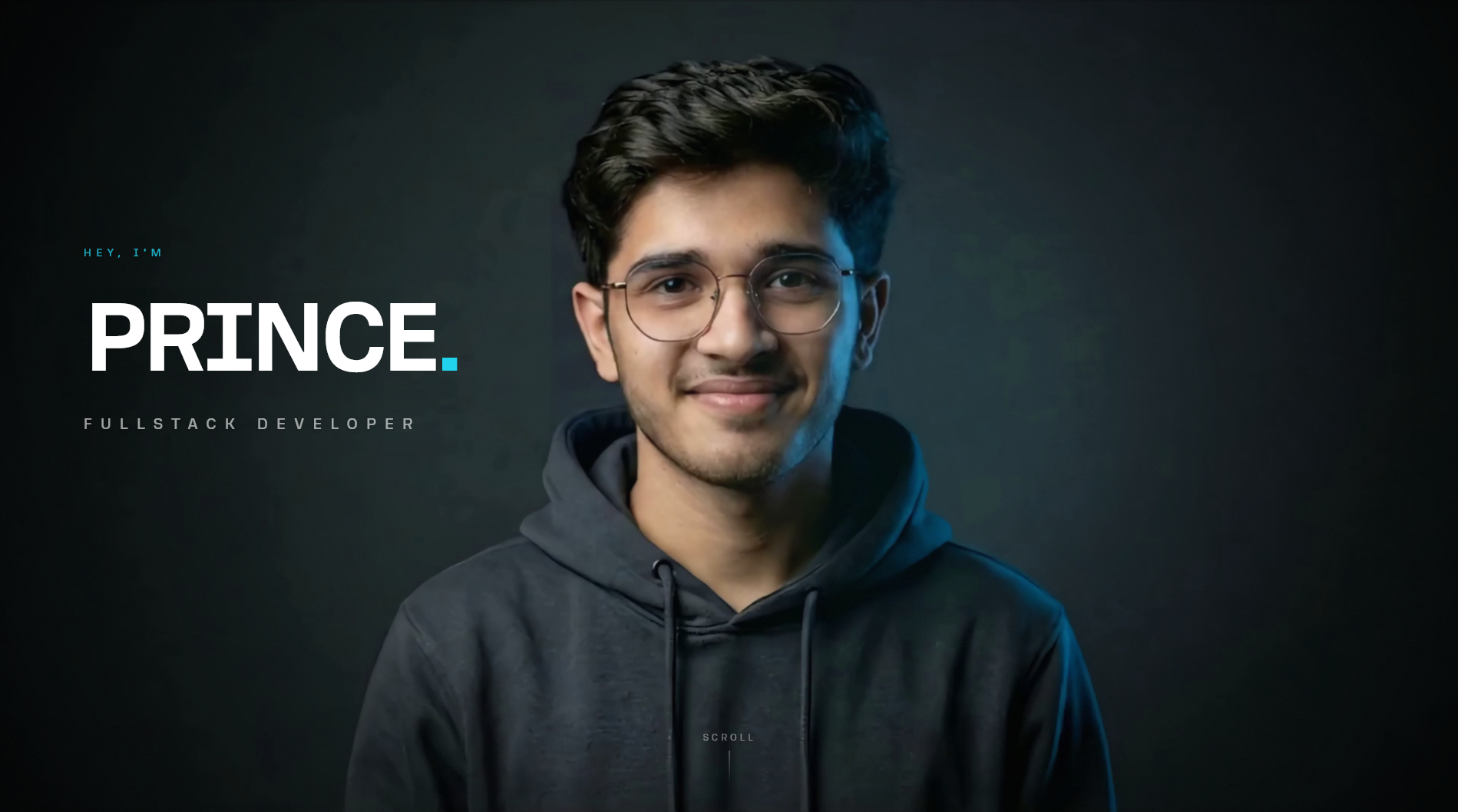
Act 1 — Face forward. You see me looking straight at you. My name appears. "Hey, I'm Prince." This is the handshake moment. Direct eye contact.
Act 2 — The turn begins. As I start rotating, text appears on the opposite side describing what I do. "I build things for the web." The negative space where my face was is now filled with my identity.
Act 3 — Facing the light. I'm now in profile, looking at this glowing screen. Text describes my approach — from idea to shipped product. The visual metaphor writes itself: I'm literally facing the work.
Act 4 — Full silhouette. You can't see my face anymore. Just a dark outline against the glow. This is where I drop a personal line — my dev philosophy. It's the most vulnerable moment visually, so it gets the most personal text.
Act 5 — The portal. Final frames. I'm small in the frame, the light source dominates. A CTA appears: "Explore my work →". The invitation. You've watched the intro. Now step through the portal into the actual portfolio.
Each act fades in and out naturally as you scroll. No buttons to click, no triggers to hit. Just scroll and the story tells itself.
Why Not Just a Video?
People ask me: why not embed a video that autoplays?
Because autoplay removes the user from the experience. They're watching something happen to them. With scroll-driven playback, they're doing it. There's a subtle but massive difference in how that registers psychologically. You feel ownership over the experience.
Also, autoplay is annoying. Let's be honest.
The Loader as Part of the Experience
While the frames load, you see a dark screen with a big counter ticking from 000 to 100. Sci-fi HUD brackets in the corners. A glowing scanline sweeping across the numbers. System-boot text like you're initializing something.
That wasn't just a loading screen. It was a mood setter. By the time the loader fades out (with a cinematic blur transition), you've already been primed for something different. You're not expecting a normal portfolio anymore. The loading screen told your brain: this is going to be an experience.
If I'd used a normal spinner or skeleton loader, the cinematic hero would've felt jarring. The loader is the bridge that says "we're entering a different world now."
The Scroll Lock Decision
One design decision I debated for a while: should the portfolio content be visible below the hero, or should it be hidden until you "complete" the cinematic intro?
I went with hidden. Here's why.
If the full page is scrollable from the start, the cinematic hero becomes something you scroll past. It's an obstacle between you and the "real" content. That ruins the whole point. It should feel like a self-contained experience — a short film that ends with an invitation.
So the portfolio content only appears after you click the CTA at the end. And if you scroll back up into the cinematic section, it hides again. The hero is its own world. The portfolio is another. The button is the doorway between them.
What It Says About Me
At the end of the day, the cinematic hero isn't a technical flex. I mean, it kind of is — but that's not the point.
The point is: I care about how things feel. Not just how they work.
Any developer can list their tech stack and link their GitHub. But the experience of scrolling through a personal film, reading text that fades in exactly when it should, feeling the weight of a spring-loaded frame sequence — that communicates something that a bullet list never will.
It says I think about the details. It says I'm not afraid to do something unconventional. It says when I build something, I build it with intention.
And honestly? It was just really fun to make.
Was It Worth It?
The cinematic hero took significantly more effort than a normal hero section. Extracting frames, building a canvas renderer, writing a progressive loader, designing the scrollytelling, tuning spring physics, handling edge cases on mobile...
Was it worth it?
Every single person who visits my portfolio mentions it. Not my projects. Not my experience section. The intro. "That opening was sick." "How did you do that?" "I've never seen a portfolio like this."
Yeah. It was worth it.
If you want to experience it yourself, head to the portfolio page and start scrolling. Just take it slow.